

- 0 commentson How can I scale embroidery files?
- by Mark Angilowski
How can I scale embroidery files?
- 0 commentson How can I scale embroidery files?
- by Mark Angilowski
Many embroidery machines allow you to scale embroidery files by ± 20%. However, this doesn't adjust the stitch count, which can lead to messy results. Learn how to correctly enlarge or reduce embroidery files—with and without software.
Almost every modern embroidery machine offers an easy way to enlarge or reduce embroidery designs on the display by ± 20%. What many people don't realize is that the number of stitches remains unchanged.
This has two consequences:
A mere change in size without adjusting the number of stitches therefore usually leads to an uneven embroidery result.

In practice, we recommend limiting the scaling on the machine to a maximum of ± 3% . Anything beyond that should be done with suitable embroidery software that intelligently adjusts the embroidery structure.
With embroidery software, you can not only view and assemble embroidery files, but also professionally scale them . The embroidery file is analyzed and the stitches are recalculated.
Example:
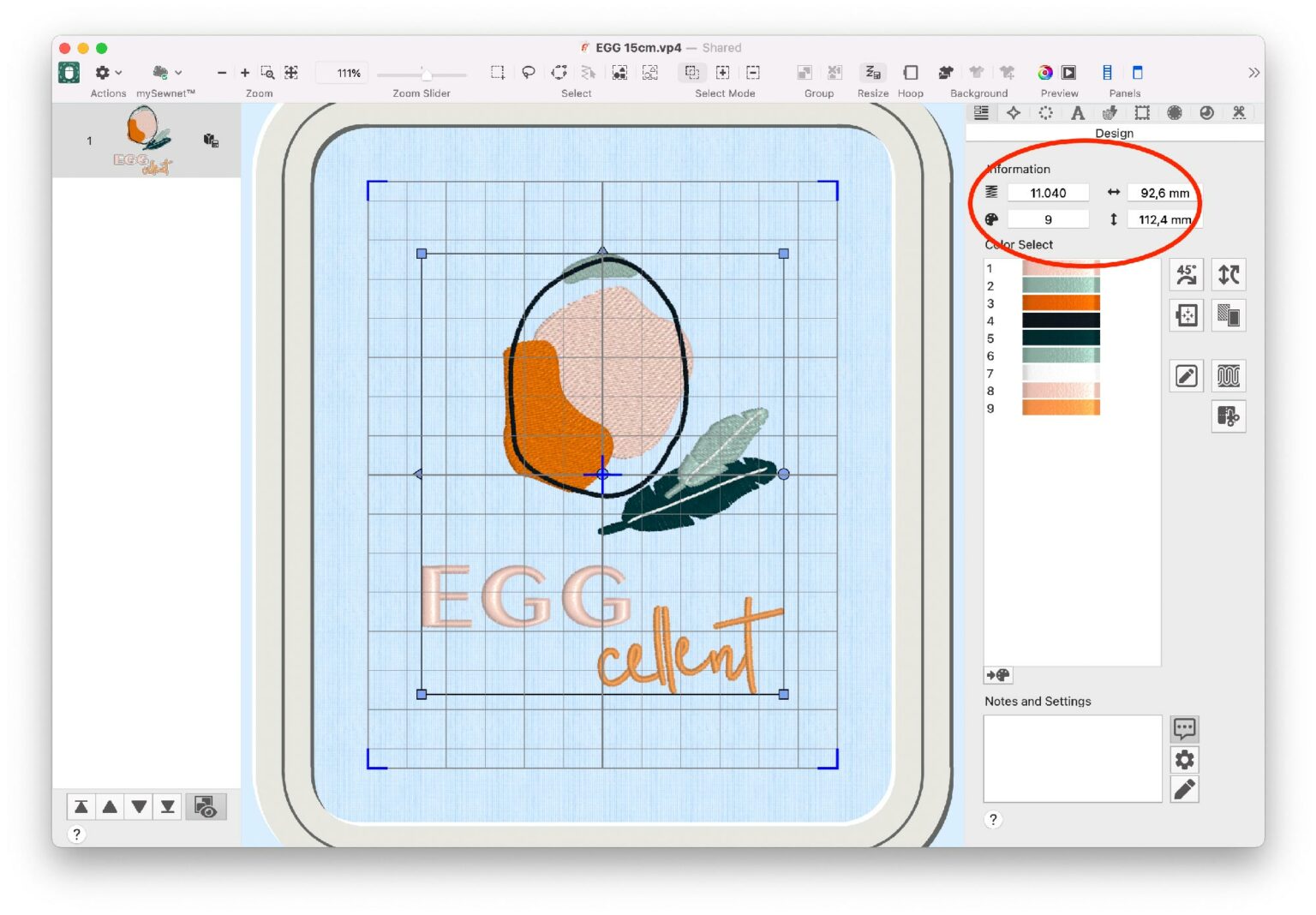
An embroidery file with a width of 119.8 mm and 13,824 stitches is reduced to 92.6 mm – the software automatically reduces the number of stitches to 11,040.

Starting with the Creativate software, a resize function is available. Here's how:
The feature recognizes various embroidery types such as areas, satin edges, or running stitches and scales them accordingly. For complex motifs, the results may vary depending on the file structure.
The resize function works with almost all common file formats, including:
Even the affordable subscription is worthwhile for simple customizations. If you regularly edit or personalize embroidery designs, we recommend upgrading to the highest version with expanded features (e.g., changing stitch types, defining underlays, adding effects).
AI embroidery designs look great – but as embroidery files, they're often completely useless
AI images often look like perfect embroidery, but are frequently unsuitable as a template for a real embroidery file. We'll show you which mistakes to avoid with AI-generated motifs, how to formulate better prompts, and how to recognise well-digitised embroidery files.
Embroider a woodland mobile: ITH ornaments step by step
Embroider fox, deer, fir tree and mushroom in a 10 × 10 cm hoop, then turn them into a woodland mobile or garland.
Read moreabout Embroider a woodland mobile: ITH ornaments step by step
Sew an alphabet cushion: personal pillows from A to Z
Sew an alphabet cushion with neat curves, even filling and a hidden ladder stitch, using a digital pattern that includes every letter from A to Z.
Read moreabout Sew an alphabet cushion: personal pillows from A to Z


Split:
Which file format does my embroidery machine use?
Why can't I open my PES embroidery file in PE Design?